The challenge
Palm Isle Skateshop is a Canadian skate shop: decks, shoes, clothing and accessories, sold in store and online and shipped across the country.
The shop wanted to move its online store from Lightspeed to Shopify. On paper, that is a platform switch. In practice, it was two problems at once.
The first was the catalogue. A skate shop's catalogue is built on sizes and colours. A shoe comes in a dozen sizes, a tee in several sizes and colourways. Lightspeed holds all of that in a product matrix. Shopify holds it as products and variants. The two structures are completely different, and there is no button that turns one into the other.
The second was the store itself. Palm Isle was keeping Lightspeed as its point of sale in the shop. So the catalogue could not just be copied over once and forgotten. Every product had to exist on both sides, matched one to one, and stock had to move between the two systems every time something sold, in store or online. One mismatch and the website sells a size that is already gone, or hides one that is sitting on the shelf.
So the real job was to take 3,000 products apart, put them back together in Shopify, tie each one back to its Lightspeed counterpart, and keep the two in sync for good. And the move came with a third job: a brand new storefront to go with it.
What we did
We started with the catalogue. Before moving a single product, we worked out how each piece of the Lightspeed matrix would translate into Shopify's products and variants. Then we rebuilt the catalogue on the Shopify side so that every product kept its sizes and colours.
Next came the matching. Each of the 3,000 products was tied to its Lightspeed record so that a size 10 shoe in the shop and a size 10 shoe online were the same item, not two. Where the matrices did not line up, we fixed them by hand rather than let a bad match slip through.
With every product matched, we built a custom bridge connector between Lightspeed and Shopify. A sale at the counter updates the stock online within minutes. An online order updates the stock in the POS. Staff keep working in the system they know, and nobody re-enters inventory twice. We have maintained the bridge since launch, so the catalogue stays matched as new products come in.
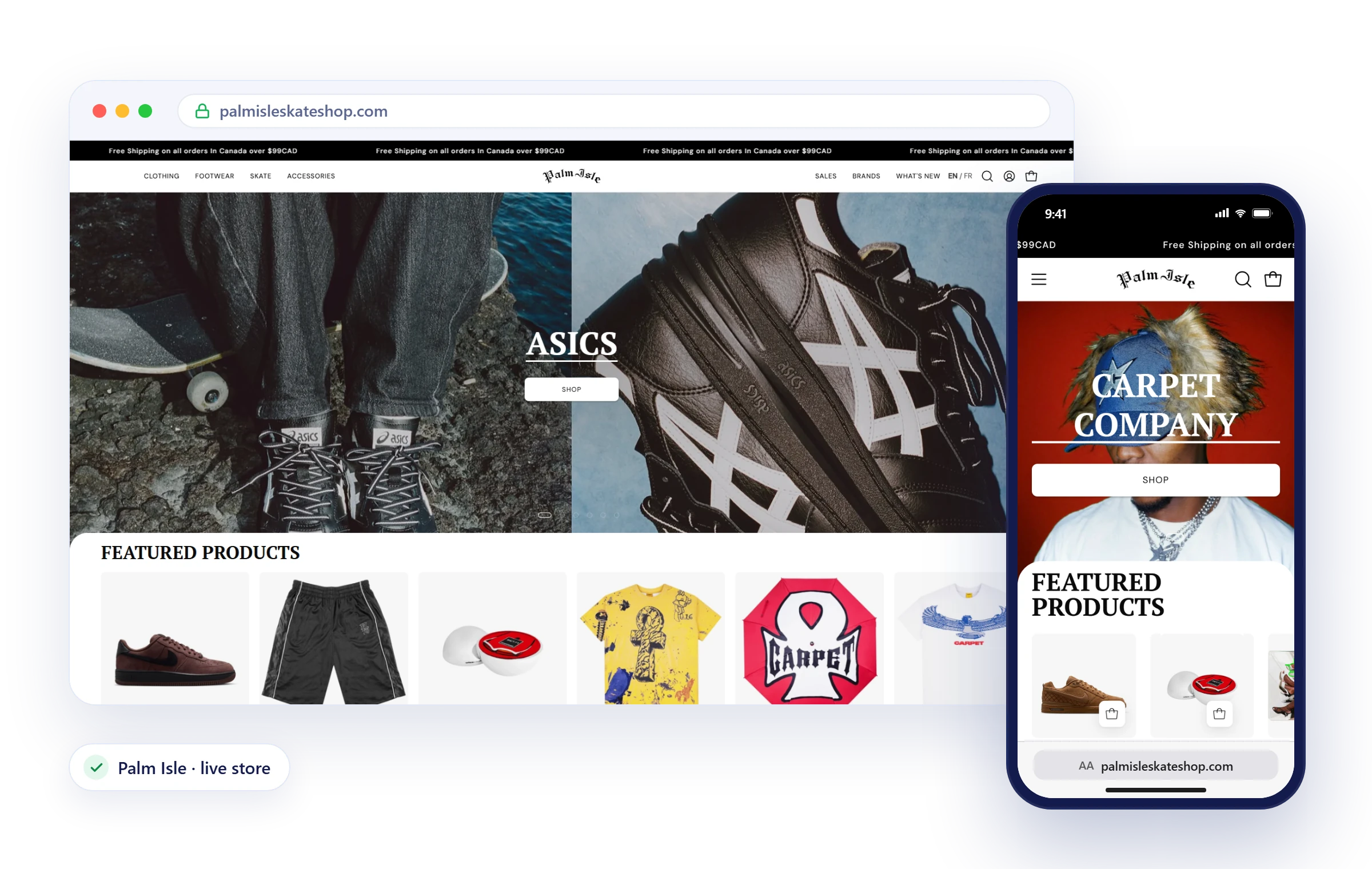
With the catalogue and the bridge in place, we designed and built the store around them. Big editorial imagery up top, featured products right below, and a navigation that follows how people actually shop a skate shop: clothing, footwear, skate and accessories, with sales, brands and new arrivals always one click away. The whole store runs in English and French.
The new site went live in the last week of November 2024, a few days before Black Friday.
The results
The results were immediate. In its first six days, Black Friday weekend included, the new store took about three times as many orders as the old one had in all of October. Stock stayed accurate online through the busiest week of the year, with one inventory serving both the shop floor and the website.
December 2024, the first full month on Shopify, closed with 45% more orders than December the year before.
And it held. Over 2025, the first full year on the new store, compared with 2024 in Google Analytics:
- Online revenue: up 36%.
- Online orders: up 43%.
- Organic search: sessions up 57% and orders up 78%.
- Inventory: 3,000 products synced between Lightspeed and Shopify and maintained since launch.
+36%
Online revenue, 2025 vs 2024
+43%
Online orders, 2025 vs 2024
+45%
Orders in the first month